
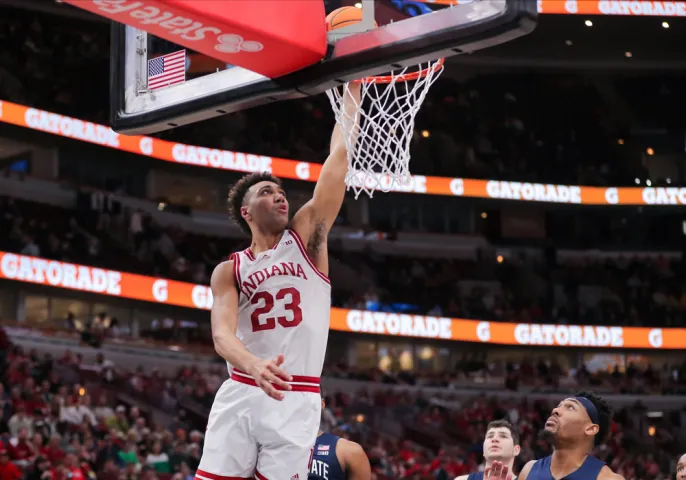
Choosing a starting five for a school like Indiana is never an easy task. The Hoosiers are one of the most decorated programs in college basketball history, boasting five banners at Assembly Hall (as they never tire of reminding archrival Purdue). That said, Indiana hasn’t hung a banner since 1987. So that makes it an even harder task, because the Hoosiers have had some great players who simply couldn’t claim the hardware.
Some will defer to Indiana’s title-winning teams, especially the three coached by Bob Knight. Others believe that individual greatness shouldn’t be docked just because the team couldn’t get it done in March. The truth is somewhere in the middle, and there will certainly be arguments for players who didn’t make this list.
But from an unbiased perspective, these five, plus a sixth man, represent some of the best to ever wear the candy-cane warmups in Bloomington.
Point Guard: Isiah Thomas
There’s really no disputing it. If Isiah Thomas hadn’t left Bloomington after two years, he’d likely own the school record for assists and it wouldn’t be close. He notched 356 assists for Indiana, and he didn’t really get established as the Hoosiers’ point guard until midway through his freshman season. Yogi Ferrell’s 633 assists top the IU record book, but Thomas’ numbers extrapolate to over 700 assists. In his sophomore year, Thomas set the record for assists in one season with 197.
And that’s in an era where teams didn’t play excessive schedules. Keep in mind, when Thomas played, there was no Big Ten tournament, there were few preseason tournaments and the NCAA tournament only had 48 teams. Thomas only played 63 games in two seasons in Bloomington; Ferrell averaged 34 games a year in four years. Thomas also wasn’t just a brilliant creator; he averaged 15.4 points per game in a time without a 3-point line.
There’s also the ultimate line on the resume: Thomas leading the Hoosiers to the national championship in 1981. He headed to the NBA after two years because there was nothing left for him to accomplish at Indiana. It’s not a stretch to call him the greatest player in Indiana history.
Shooting Guard: Steve Alford
Even though he’s probably the greatest shooter in Indiana history, Steve Alford was still a couple of years before his time. That’s the reason he’s No. 2 on Indiana’s all-time scoring list behind Calbert Cheaney. When Alford arrived in Bloomington, there was no 3-point line in most of college basketball. That wouldn’t come in until his senior season, and the shot clock wasn’t introduced until his junior year.
Those two things changed the game, and Alford would have been perfectly positioned to take advantage of both. In his senior year, he showed just what he could have done by shooting an unthinkable 53% from behind the arc. He averaged 22 points per game that season and finished with an average of 19.5 points for his career.
Like Thomas, Alford got the ultimate prize, as the Hoosiers won the 1987 NCAA title, the most recent one they’ve won to this point. Like Thomas, Alford was more than just his specialty: he was a brilliant defender (second all-time in steals) and could dish the rock whenever the situation called for it. He was also one of the best leaders the Hoosiers have ever had, and he’s parlayed that experience into a moderately successful coaching career.
Alford’s college career was so impressive that he’s one of the few players who could be named as Indiana’s best over Thomas and few people would bat an eye. And still, it’s fair to wonder just how good he would have been had he come just a couple years later.
Small Forward: Scott May
Scott May represents the greatest what-if for Hoosier fans, and certainly for Bob Knight. Knight believed, with plenty of justification, that the Hoosiers would have won back-to-back national titles in 1975 and 1976 if May hadn’t broken his arm against Purdue near the end of the 1975 season. With May limited, the Hoosiers lost to Kentucky, which would go on to lose to UCLA in the final in John Wooden’s last game and 10th national championship.
Knight believed that with a healthy May, Indiana would have reached that game and denied the Wizard of Westwood his final title. And it’s hard to argue. May was the best player on a loaded Indiana squad, averaging 23.5 points and 7.7 rebounds per game in the championship season of 1976.
Twice, May earned first-team All-America honors, becoming national player of the year in 1976. In the face of all of his scoring, it was easy to overlook his defense, but he was almost as good at preventing points as he was at scoring them. May’s not on any career top ten lists because he only played three seasons, but his 752 points in 1976 ranks second all-time, and he’s the single-game leader in steals.
Power Forward: Trayce Jackson-Davis
Indiana basketball really hasn’t been “Indiana basketball” the past several decades, and that’s evident by the lack of star power past Bob Knight’s exit. But Trayce Jackson-Davis was a truly special talent. Everyone knew he was going to be special when he made the short move from Greenwood to Bloomington for college, and the homegrown product certainly did not disappoint.
Jackson-Davis is the only Hoosier who played in a year starting with a 2 to appear on the top 10 list for both points and rebounds. He’s the all-time leader in rebounds with 1,143, and given how players don’t stay for four years very often anymore, that might never be passed.
The only knock on Jackson-Davis is team success. He played for a pair of coaches who couldn’t get the job done in Archie Miller and Mike Woodson. It’s not his job to go out and build the roster; Miller and Woodson had a generational talent and couldn’t take advantage of it. Under a coach who knew what he was doing, Jackson-Davis likely makes a Final Four and possibly wins a national title. Even so, he was one of the most dominant players in the country at a time when Purdue had Zach Edey. And all of that makes him a no-brainer for this list, even without the postseason success.
Center: Kent Benson
Even though Jackson-Davis spent most of his time at the center position, the presence of Benson allows him to slide over to the 4, and Indiana’s all-time team is better for it. Benson was a truly dominant center in an era where you needed a big man to have any chance. He was the most outstanding player at the Final Four in 1976, when Indiana became the last team to complete a perfect season at 32-0.
Like Jackson-Davis, Benson appears in the top 10 in both points and rebounds. Jackson-Davis did bump Benson down to the bottom of the top 10, but Benson still scored 1,740 points and snagged 1,031 rebounds in his four years at Indiana. He was one of the best centers in Big Ten history, and that’s no small feat.
Sixth Man: Calbert Cheaney
Indiana’s leading scorer of all time has to be on here somewhere, but how could you bump off either Thomas or Alford? Cheaney was a great player for Indiana, but he wasn’t quite on the level of those two.
Still, he was one of the best shooters in Indiana history, and he’d be a great choice to come off the bench when one of them needs a rest. He was an excellent deep shooter and had the advantage of playing all four years with a 3-point line. In his senior year, he averaged 22.4 points per game and helped the Hoosiers reach the Elite Eight.
That’s another reason why Cheaney sits a bit behind Thomas and Alford; he fell short of winning a championship. That’s not his fault; Indiana ran into Duke in 1992 and fell just short of denying the Blue Devils back-to-back national titles. Winning a title also wouldn’t have elevated him above either star. Sixth man feels like the right spot for him on IU’s all-time list.
Want more Sandman? Come connect with us here at sandmansports.com/staging/8269/onestopshop
